
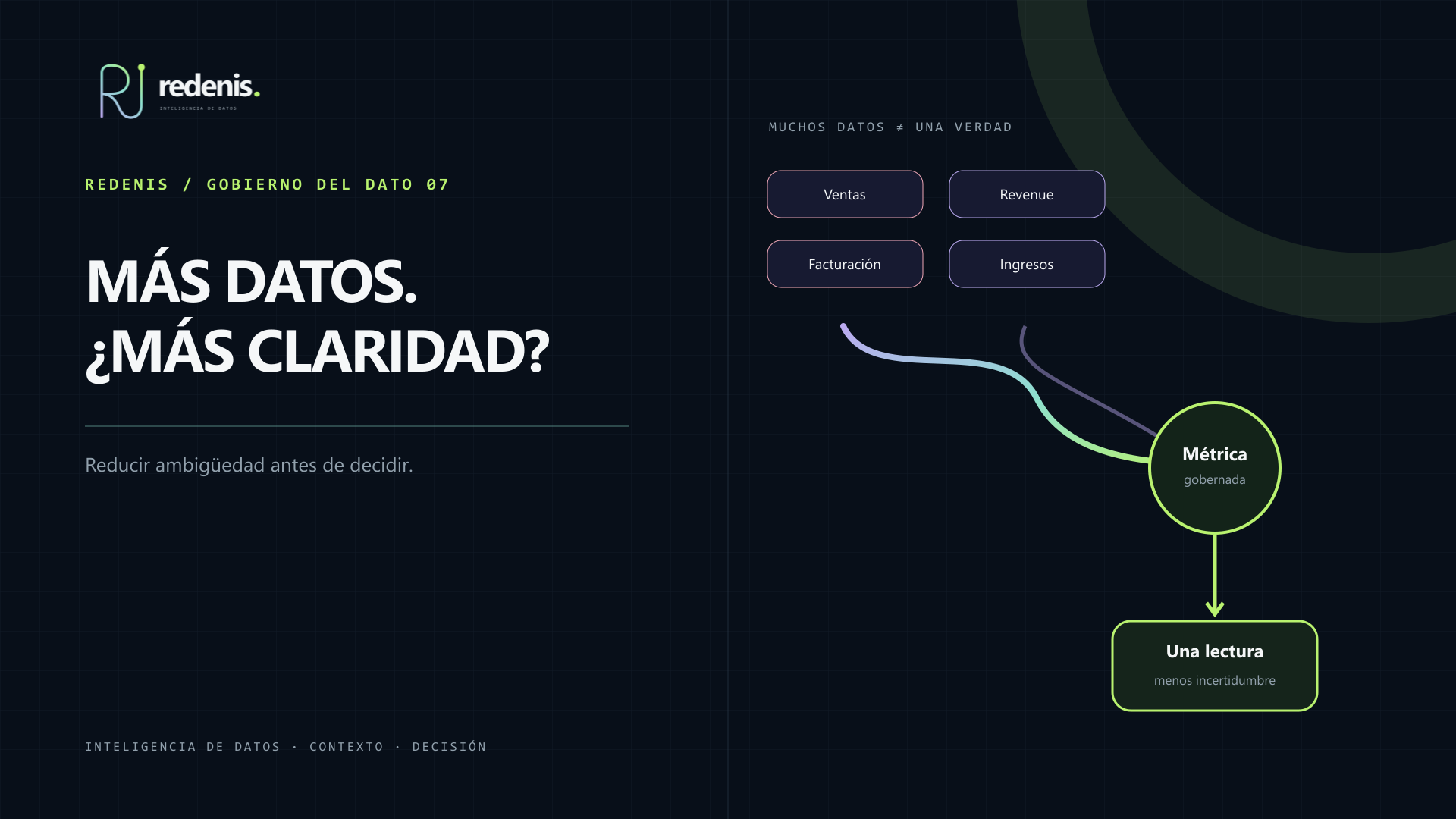
This article expands on the reflection originally shared on LinkedIn: an organisation does not become more mature by accumulating more data, reports or metrics. It matures when it reduces the uncertainty with which information reaches people. If sales, revenue and billing mean something different in every report, more figures create more interpretations rather than more clarity.
Data maturity becomes visible when one question stops producing several truths.
Information entropy inside an organisation
Entropy appears when the same definition is replicated across SQL, Power Query, DAX and spreadsheets; when every team applies different filters; or when nobody can reconstruct the origin of an indicator. The data exists, but its meaning is unstable.
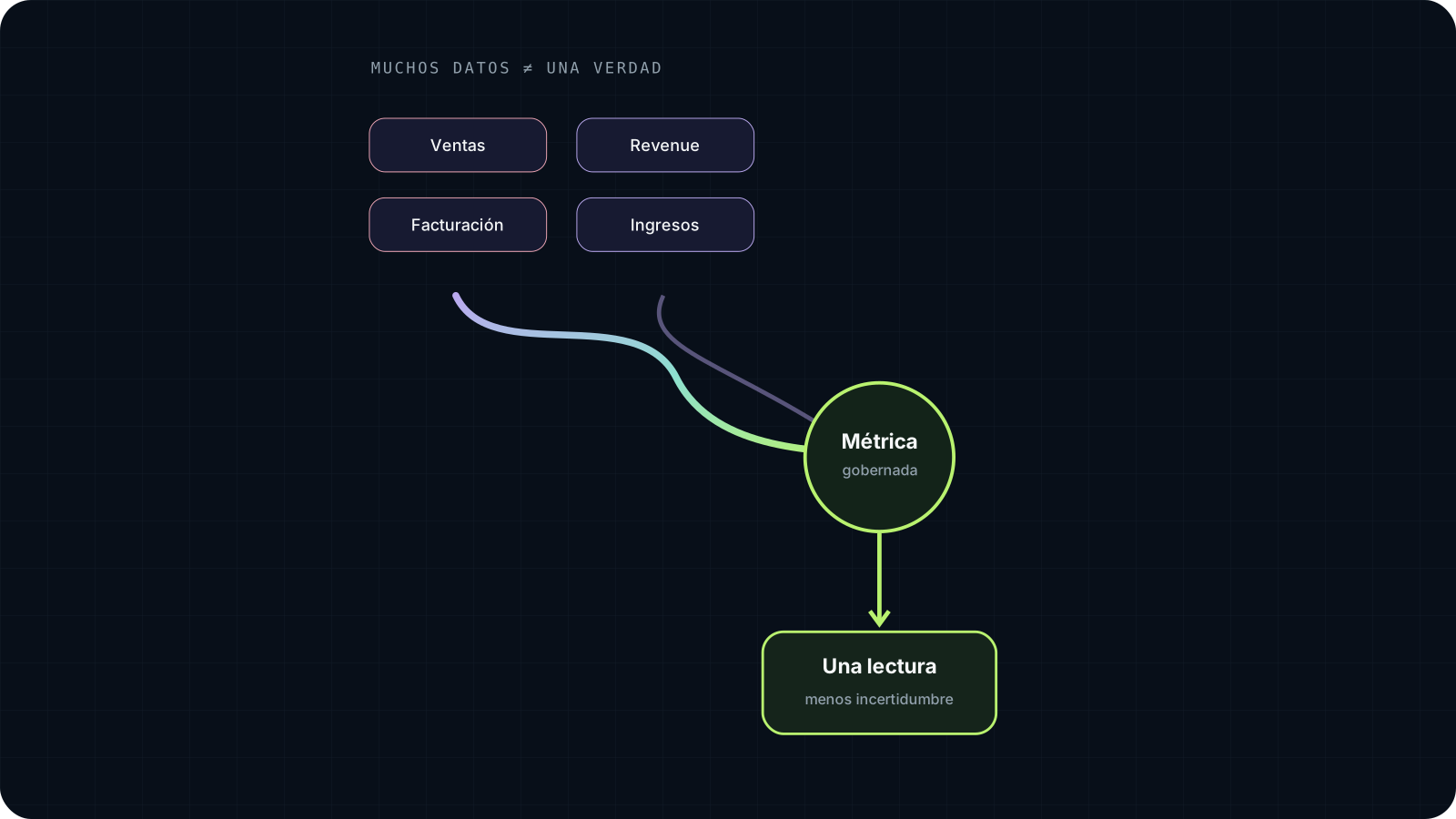
Four recurring causes
| Cause | Signal | Impact |
|---|---|---|
| Duplicated definitions | The same KPI changes across reports | Teams debate the number before the decision |
| Scattered logic | Rules live in several layers | Testing and maintenance become expensive |
| Missing context | Scope and filters are unclear | Comparisons become misleading |
| Broken lineage | The journey cannot be reconstructed | Trust falls and incidents last longer |
Compressing information into knowledge
Reducing entropy requires identifiable sources, layers with clear responsibilities, reusable semantic models and metrics with an owner, formula, scope and cadence. Catalogue and lineage reveal both meaning and dependencies.
Clarity is a product
The goal of governance is to resolve technical complexity before it reaches the business conversation. When data already carries definition, traceability and context, the meeting can focus on the decision.