
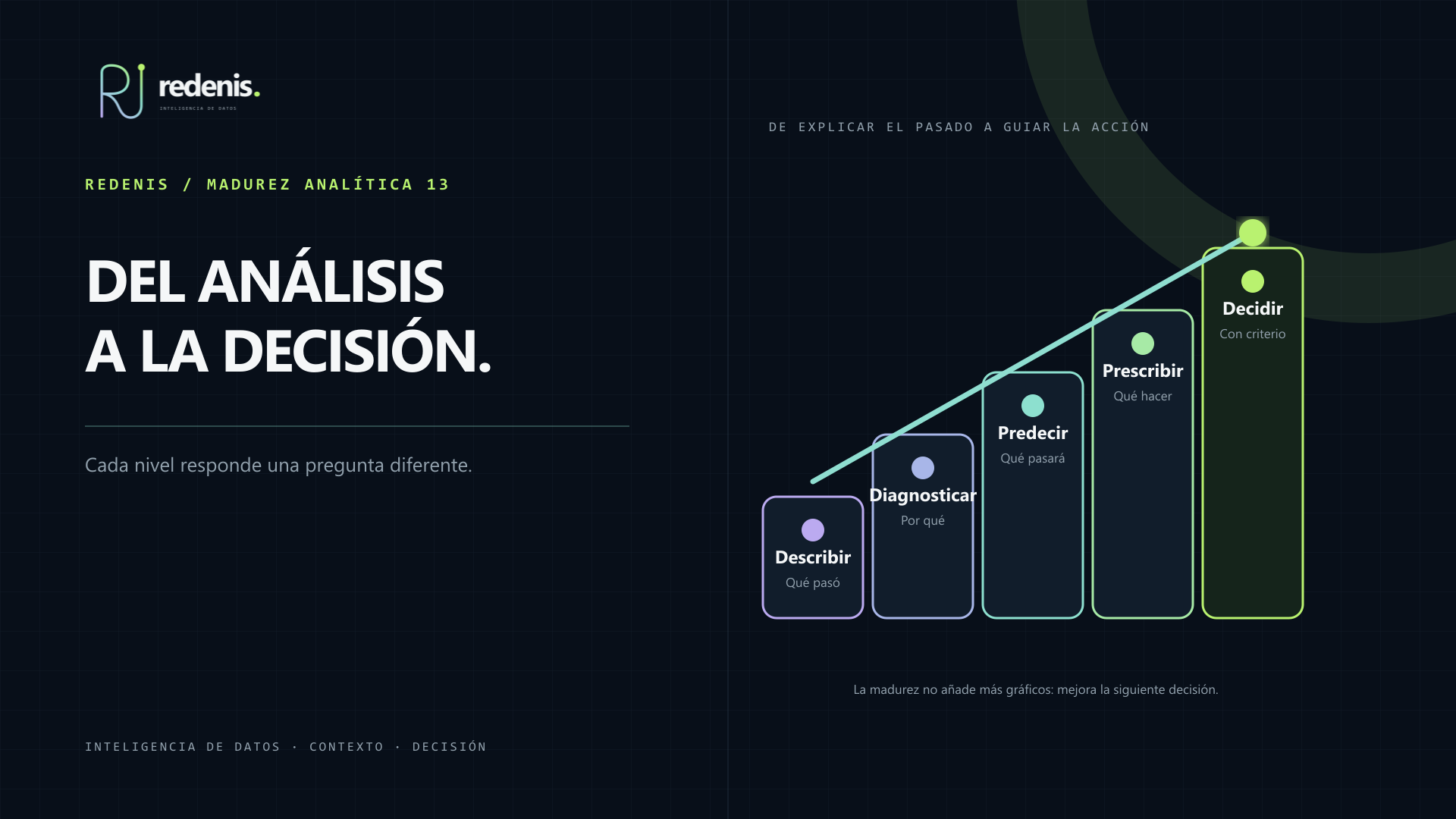
This article expands on the journey introduced on LinkedIn: analysis often began by explaining what had happened in spreadsheets. Questions then moved towards causes, future scenarios and recommended actions. Evolution does not mean replacing one level with the next, but connecting them so every answer prepares a better decision.
Analytics maturity is not measured by the most advanced algorithm, but by the decision we can improve.
Five questions, five levels
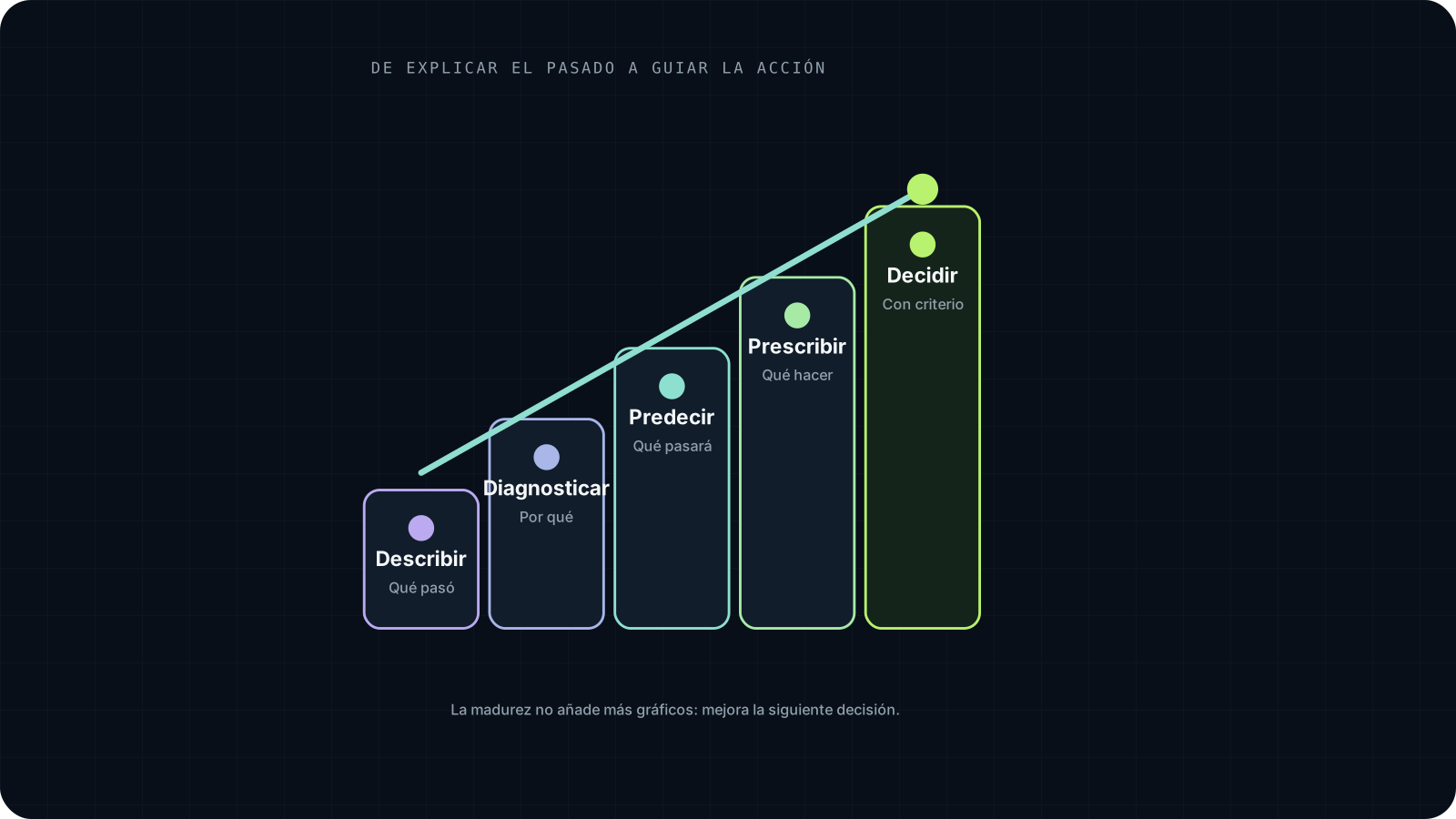
| Level | Question | Outcome |
|---|---|---|
| Descriptive | What happened? | Situation and trend |
| Diagnostic | Why? | Drivers and segments |
| Predictive | What may happen? | Forecast and risk |
| Prescriptive | What should we do? | Options and recommendation |
| Guided decision | What will we do and learn? | Action and feedback |
The mistake of jumping straight to AI
An advanced model cannot compensate for unstable definitions, incomplete data or a decision without an owner. Choose the simplest method that reduces the relevant uncertainty, integrate it into the process and measure the outcome.
Turning analysis into learning
The cycle closes when the action returns to the system as evidence. Recommendation, decision and result improve hypotheses and models, turning analytics into a capability that learns.